Definition
Given the density matrix ρ, von Neumann defined the entropy as
which is a proper extension of the Gibbs entropy (up to a factor ) and the Shannon entropy to the quantum case. To compute S(ρ) it is convenient (see logarithm of a matrix) to compute the Eigendecomposition of . The von Neumann entropy is then given by
Since, for a pure state, the density matrix is idempotent, ρ=ρ2, the entropy S(ρ) for it vanishes. Thus, if the system is finite (finite dimensional matrix representation), the entropy S(ρ) quantifies the departure of the system from a pure state. In other words, it codifies the degree of mixing of the state describing a given finite system. Measurement decoheres a quantum system into something noninterfering and ostensibly classical; so, e.g., the vanishing entropy of a pure state |Ψ⟩ = (|0⟩+|1⟩)/√2, corresponding to a density matrix

increases to S=ln 2 =0.69 for the measurement outcome mixture
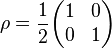
as the quantum interference information is erased.
Read more about this topic: Von Neumann Entropy
Famous quotes containing the word definition:
“It is very hard to give a just definition of love. The most we can say of it is this: that in the soul, it is a desire to rule; in the spirit, it is a sympathy; and in the body, it is but a hidden and subtle desire to possess—after many mysteries—what one loves.”
—François, Duc De La Rochefoucauld (1613–1680)
“Scientific method is the way to truth, but it affords, even in
principle, no unique definition of truth. Any so-called pragmatic
definition of truth is doomed to failure equally.”
—Willard Van Orman Quine (b. 1908)
“One definition of man is “an intelligence served by organs.””
—Ralph Waldo Emerson (1803–1882)