Type Theory
In type theory, sets are generally identified with their indicator function: accordingly, a set of values of type may be denoted by or . (Subtypes and subsets may be modeled by refinement types, and quotient sets may be replaced by setoids.) The characteristic function F of a set S is defined as: 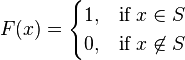
In theory, many other abstract data structures can be viewed as set structures with additional operations and/or additional axioms imposed on the standard operations. For example, an abstract heap can be viewed as a set structure with a min(S) operation that returns the element of smallest value.
Read more about this topic: Set (abstract Data Type)
Famous quotes containing the words type and/or theory:
“A cigarette is the perfect type of a perfect pleasure. It is exquisite, and it leaves one unsatisfied. What more can one want?”
—Oscar Wilde (1854–1900)
“Many people have an oversimplified picture of bonding that could be called the “epoxy” theory of relationships...if you don’t get properly “glued” to your babies at exactly the right time, which only occurs very soon after birth, then you will have missed your chance.”
—Pamela Patrick Novotny (20th century)