Mathematical Description
Fluid flow is governed by the momentum equation (often called the Navier-Stokes equation) which is essentially a statement of Newton's second law for the fluid. The velocity in a fluid with viscosity under pressure and rotating at rate changes over time according to

To be precise, is the velocity of the fluid as observed in the rotating frame of reference. Since a rotating frame of reference is accelerating (i.e. non-inertial frame), two additional (pseudo)forces (as mentioned above) emerges as the result of this coordinate transformation: the centrifugal force and the Coriolis force. In the equation above, the centrifugal force is included as a part of the generalized pressure, that is, is related to the usual pressure, depending on the distance from the rotation axis, by
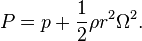
The last term on the right side of the momentum equation is the Coriolis term. The first term on the right accounts for pressure, and the second accounts for viscous diffusion.
In the case where the rotation rate is large, the Coriolis force and the centripetal force become large compared to the other terms. Being small in comparison, diffusion and the "convective derivative" (second term on the left) can be left out. Taking a curl of both sides and applying a few vector identities, the result is
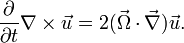
One class of solutions to this equation are waves that satisfy two conditions. First, if is the wave vector,

that is, the waves must be transverse, as mentioned above. Second, solutions are required to have a frequency that satisfies the dispersion relation

where is the angle between the axis of rotation and the direction of the wave. These particular solutions are known as inertial waves.
The dispersion relation looks much like the Coriolis term in the momentum equation—notice the rotation rate and the factor of two. It immediately implies the range of possible frequencies for inertial waves, as well as the dependence of their frequency on their direction.
Read more about this topic: Inertial Wave
Famous quotes containing the words mathematical and/or description:
“The most distinct and beautiful statement of any truth must take at last the mathematical form.”
—Henry David Thoreau (1817–1862)
“Whose are the truly labored sentences? From the weak and flimsy periods of the politician and literary man, we are glad to turn even to the description of work, the simple record of the month’s labor in the farmer’s almanac, to restore our tone and spirits.”
—Henry David Thoreau (1817–1862)